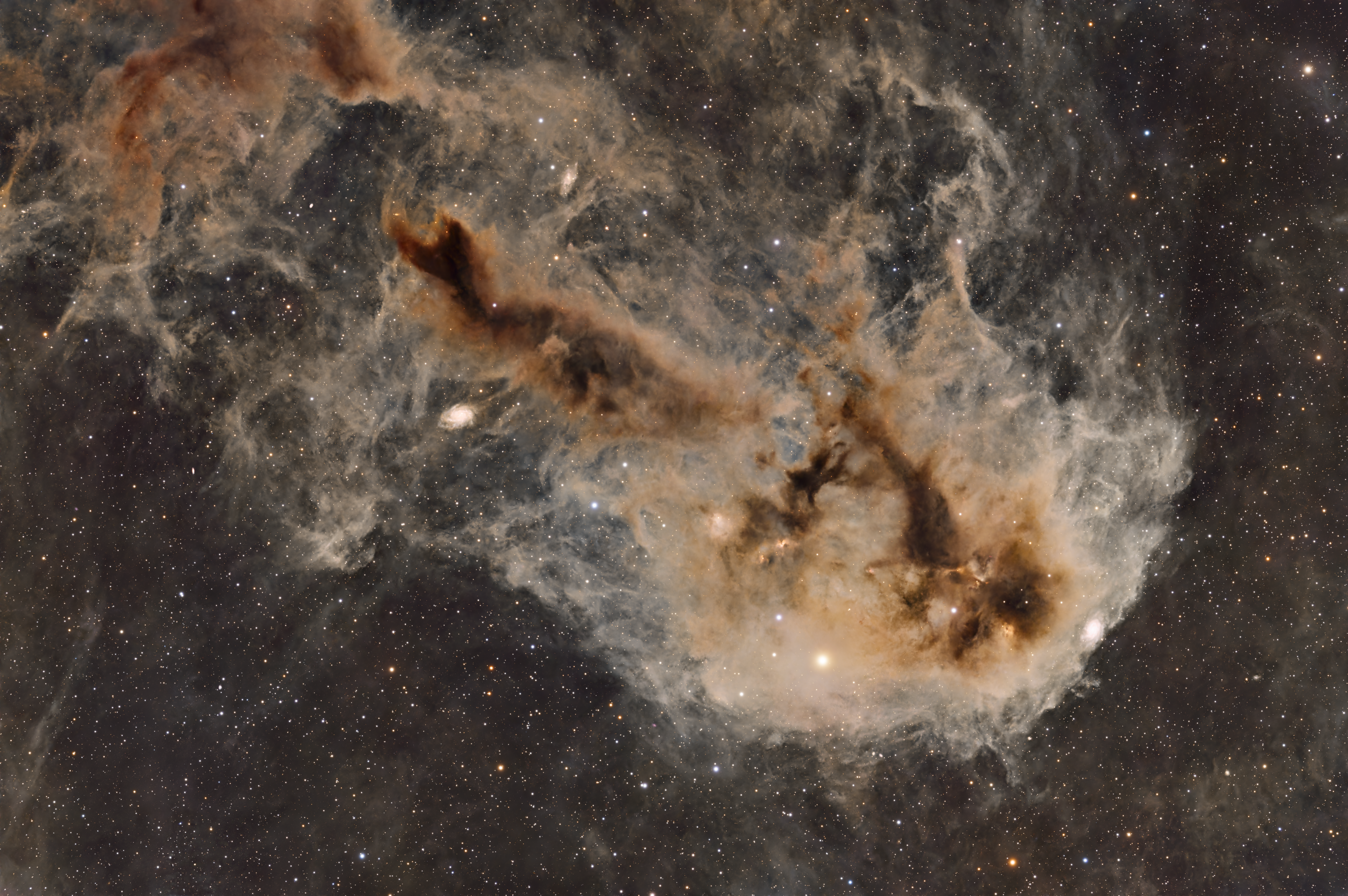
LDN 1251
Key Astrophysical Data
Catalog Designations
LDN 1251, Rotten Fish Nebula
Position in the Sky
Cepheus (RA 22h 35m 12s / Dec +75° 14′ 30″)

Apparent Size
~60′ × 30′ (Main cloud structure)
Apparent Magnitude
N/A (Opaque Dark Nebula)
Discovery Date
1962 (Beverly Lynds Catalog)
Object Type
Dark Nebula / Molecular Cloud
Distance from Earth
~1,000 Light Years
Physical Size
~17 Light Years across
Power Source
Hidden Protostars & HH Objects
Object Overview & Facts
Visual Appearance & Pareidolia: Set against a remarkably starry background, LDN 1251 is shaped like a dark comet or, as amateur astronomers often point out, a swimming tadpole or a "Rotten Fish." The thick concentration of interstellar soot and molecular dust blocks out the visible light of the Milky Way behind it, creating a striking void in the sky.
Hidden Stellar Nursery: While it may look dead and cold from the outside, LDN 1251 is a highly active star-forming region. Infrared observations have pierced the dusty veil, revealing multiple young stellar objects (YSOs). As these protostars form, they interact violently with the surrounding gas.
Herbig-Haro Objects: The dark cloud is punctuated by energetic phenomena known as Herbig-Haro (HH) objects—specifically HH 189. These are created when narrow jets of partially ionized gas ejected by newborn stars collide with nearby clouds of gas and dust at speeds of several hundred kilometers per second, glowing subtly in deep images.
Faint Luminescence & ERE: Despite being categorized as a dark nebula, deep exposures reveal that the dust is not entirely black. The edges of the cloud exhibit a faint, warm brownish-red glow. This is caused by starlight from the surrounding Milky Way scattering off the dust particles, a phenomenon related to Extended Red Emission (ERE) and faint reflection nebulae.
Astrophotography Guide: LDN 1251 is a notoriously difficult target for astrophotographers. Unlike emission nebulae that can be captured from cities using narrowband filters, dark nebulae require truly dark skies. Capturing the faint, wispy molecular dust extending off the main body demands many hours of broadband (OSC or LRGB) exposure, fast optics, and meticulous gradient removal in post-processing.
Deep Sky Objects Size Comparison Laboratory
Interactive Scaling Explanation: This panel acts as a dynamic comparator of angular sizes in the night sky. All selected objects are rendered exactly over each other from a common center, allowing an immediate, direct comparison. The Full Moon (diameter 31') serves as a permanent baseline reference.
Cosmic Time Machine: LDN 1251 vs. Earth's History
The Photon Arrives: Right now, the light captured in this photograph is ending its roughly 1,000-year journey through deep space, hitting your camera's digital sensor. Move the slider back in time to see what humanity was doing while these precise photons were rushing through the void.
Cosmic Scale: Distance Map Laboratory
Dynamic Linear Scaling & Manipulation: This view builds an interactive, deep-space linear cosmic coordinate system. When swapping objects, the line auto-calculates its limit. Leave only near targets (Pleiades, Orion) checked to reveal detailed stellar gaps inside our galactic neighborhood. Turn on remote galaxies (Andromeda, Whirlpool) to watch the Milky Way bundle together on the left margin. Use your mouse wheel to zoom in/out and drag to pan across space to explore cluttered zones!