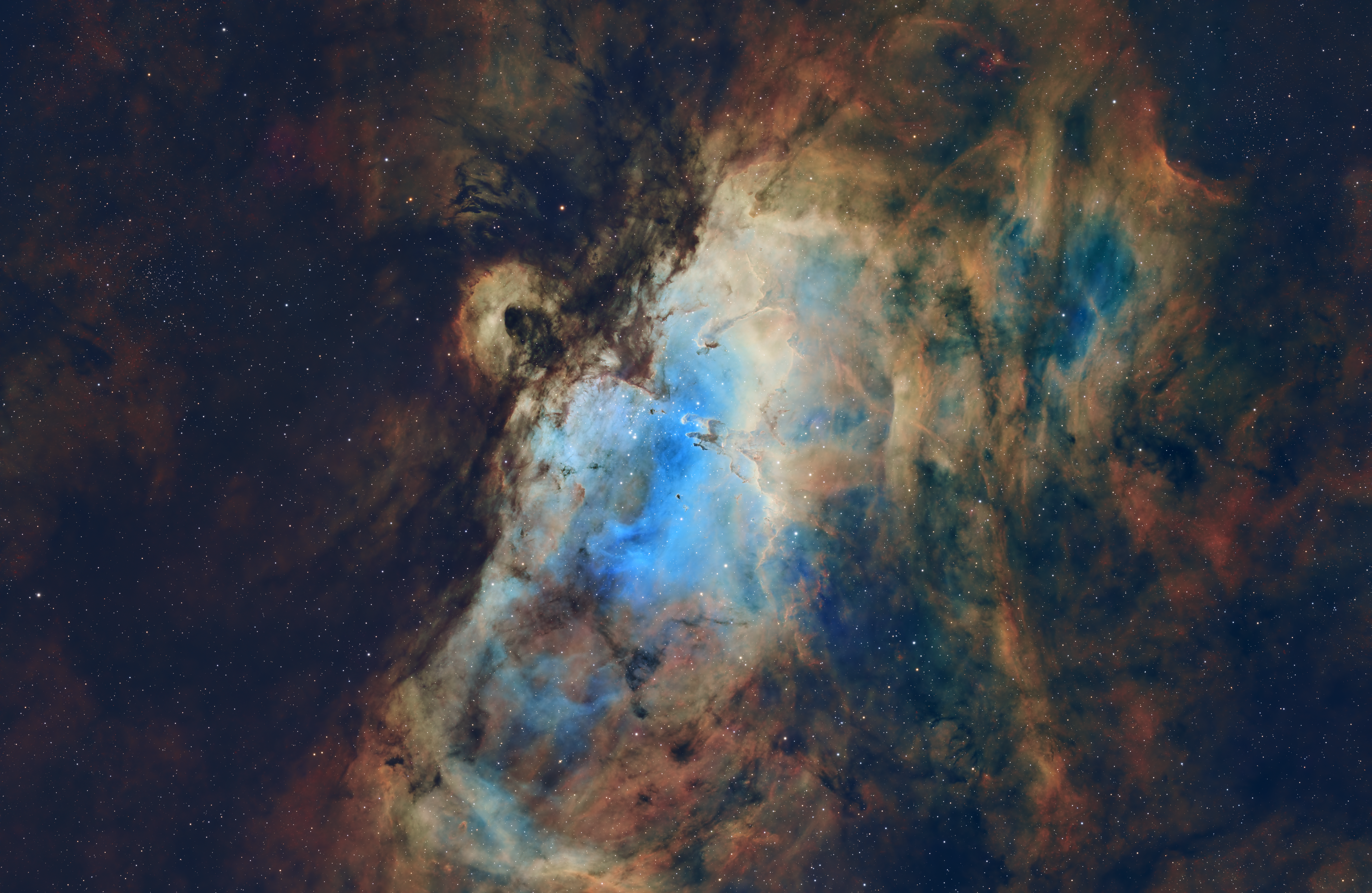
M16
Key Astrophysical Data
Catalog Designations
M16, NGC 6611, IC 4703, The Eagle Nebula
Position in the Sky
Serpens (RA 18h 18m / Dec -13° 49′)

Apparent Size
~30′ (Nebula) / ~7.0′ (Cluster)
Apparent Magnitude
+6.0 (Cluster visible in binoculars)
Discovery Date
1745 (J.-P. de Chéseaux) / 1764 (C. Messier)
Object Type
Emission Nebula & Open Cluster
Distance from Earth
~7,000 Light Years
Physical Size
~70 × 55 Light Years across
Power Source
NGC 6611 (Open Star Cluster)
Object Overview & Facts
The Pillars of Creation: Made incredibly famous by the Hubble Space Telescope in 1995, the defining features of M16 are massive elephant trunks of interstellar gas and dust. Reaching up to 4 to 5 light-years in length, these towering structures are slowly being eroded away (photoevaporated) by the intense ultraviolet light emitted by the nearby massive stars.
Evaporating Gaseous Globules (EGGs): Hidden at the very tips and edges of the Pillars are dense, dark pockets of gas known as EGGs. As the lighter, less dense gas of the pillar is stripped away by stellar winds, these dense nodules remain intact. They act as protective cocoons, sheltering embryonic protostars that are currently gravitationally collapsing to form the next generation of stars.
Power Source - NGC 6611: The radiant heart of the Eagle Nebula is the incredibly young open star cluster NGC 6611, estimated to be only 1 to 2 million years old. Formed directly from the gas of the surrounding nebula, this cluster contains extremely massive, hot O-type stars. Their monumental radiation output not only ionizes the surrounding hydrogen, making the nebula glow, but is the exact chisel carving out the Pillars.
The Stellar Fairy: Aside from the iconic Pillars, M16 features another prominent dusty silhouette on its eastern edge, affectionately known as the "Stellar Spire" or "The Fairy." Standing nearly 10 light-years tall, this structure showcases the exact same magnificent star-forming processes and turbulent stellar winds as the central Pillars.
Astrophotography Guide: For astrophotographers, M16 is a highly rewarding summer target. Because it is an active H II region rich in ionized gases, mapping the nebula using the Hubble Palette (SHO) yields spectacular results. The strong oxygen (OIII) signal in the core provides a stunning blue backdrop that contrasts violently against the dense, golden-orange tendrils of hydrogen (Ha) and sulfur (SII).
Deep Sky Objects Size Comparison Laboratory
Interactive Scaling Explanation: This panel acts as a dynamic comparator of angular sizes in the night sky. All selected objects are rendered exactly over each other from a common center, allowing an immediate, direct comparison. Spanning roughly 30 arcminutes, the entire Eagle Nebula covers an area of the sky very similar to the apparent size of the Full Moon (31').
Cosmic Time Machine: M16 vs. Earth's History
The Photon Arrives: Right now, the light captured in this photograph is ending its roughly 7,000-year journey through deep space, hitting your camera's digital sensor. Move the slider back in time to see what humanity was doing while these precise photons were rushing through the void.
Cosmic Scale: Distance Map Laboratory
Dynamic Linear Scaling & Manipulation: This view builds an interactive, deep-space linear cosmic coordinate system. At approximately 7,000 light-years away, M16 is located deep within the Sagittarius Arm of the Milky Way, placing it significantly further out than winter targets like the Orion Nebula or the Pleiades.