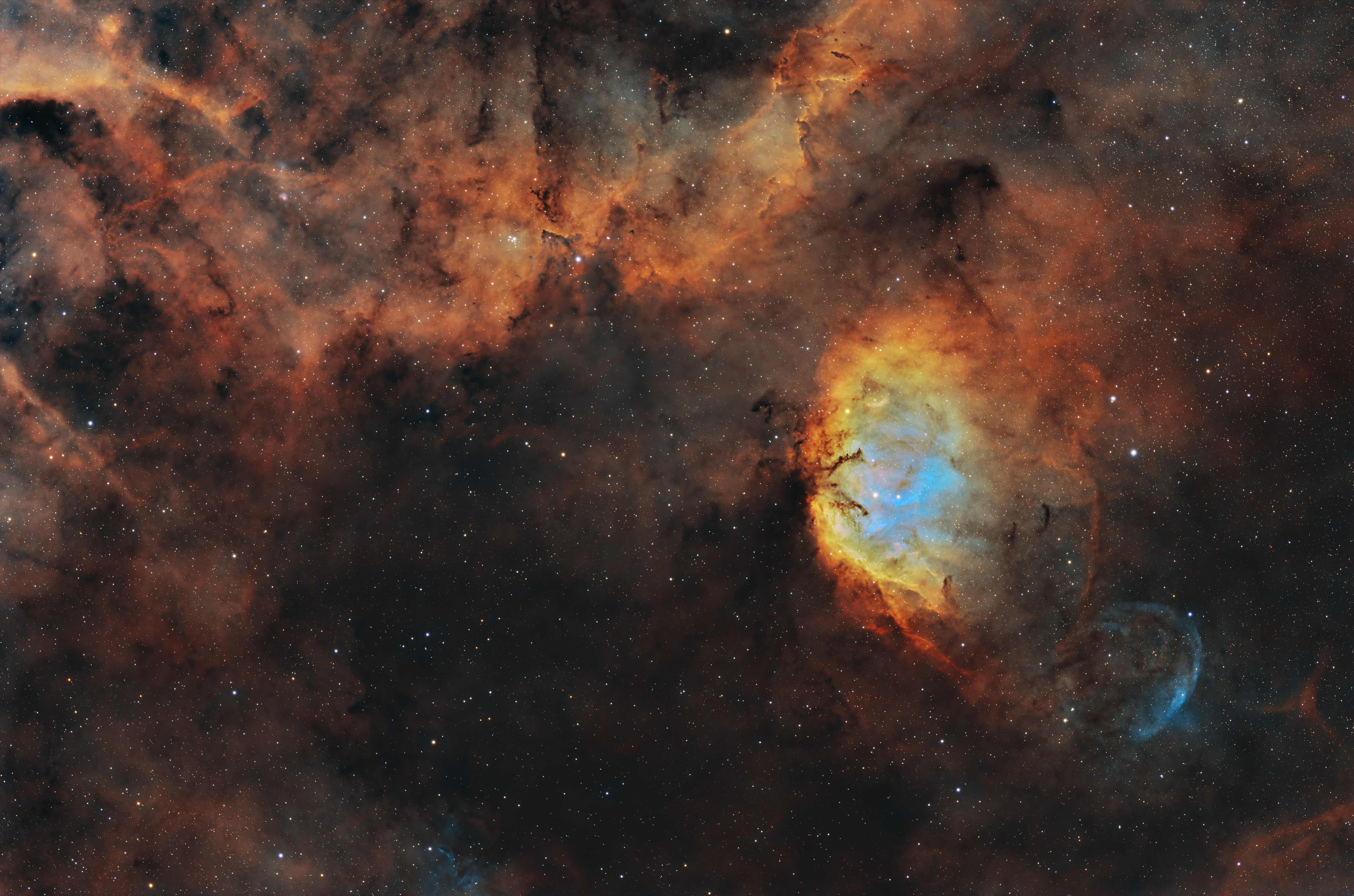
SH2-101
Key Astrophysical Data
Catalog Designations
SH2-101, Sharpless 101, Tulip Nebula
Position in the Sky
Cygnus (RA 19h 59.9m / Dec +35° 16′)

Apparent Size
~16′ × 9′
Apparent Magnitude
+9.0 (Faint emission, requires long exposure)
Discovery Date
1959 (Stewart Sharpless Catalog)
Object Type
Emission Nebula / H II Region
Distance from Earth
~6,000 Light Years
Physical Size
~70 Light Years across
Power Source
HDE 227018 (Young O-type Star)
Object Overview & Facts
Visual Appearance & Pareidolia: SH2-101 bears a striking resemblance to a blossoming tulip. This elegant structure is sculpted by strong stellar winds pushing against dense clouds of interstellar gas and dust. The "petals" of the flower consist of brilliant, glowing hydrogen gas, while darker ribbons of opaque dust create beautiful depth and contrast.
The Cygnus X-1 Connection: One of the most thrilling facts about the Tulip Nebula is its proximity to Cygnus X-1, the first widely accepted black hole discovered by astronomers. Located just off the edge of the nebula's petals, this microquasar system consists of a supergiant star and a stellar-mass black hole locked in a tight orbit. The black hole's incredibly powerful, relativistic jets blast into the surrounding gas of the nebula, creating a distinct, arc-shaped bow shock that glows faintly in Oxygen-III wavelengths.
A Furnace of Ionization: While Cygnus X-1 is nearby, the nebula itself is primarily illuminated and ionized by HDE 227018, a very young and extremely hot O-type star located near the center of the structure. The immense ultraviolet radiation emitted by this star strips electrons from the surrounding hydrogen, oxygen, and sulfur atoms, causing them to emit the vibrant colors we capture in narrowband imaging.
History of Discovery: SH2-101 was cataloged in 1959 by the American astronomer Stewart Sharpless as part of his second comprehensive list of H II regions (the Sharpless Catalog). Sharpless used photographs from the Palomar Sky Survey to identify these massive glowing clouds across the Milky Way.
Astrophotography Guide: For amateur astrophotographers, the Tulip Nebula is a fantastic, though challenging, target. Its Hydrogen-alpha signal is incredibly robust, making the basic shape relatively easy to capture. However, pulling out the delicate details of the Oxygen-III and Sulfur-II structures—and especially the faint Cygnus X-1 bow shock—requires extremely dark skies or heavy integration time through ultra-narrowband filters.
Deep Sky Objects Size Comparison Laboratory
Interactive Scaling Explanation: This panel acts as a dynamic comparator of angular sizes in the night sky. All selected objects are rendered exactly over each other from a common center, allowing an immediate, direct comparison. The Full Moon (diameter 31') serves as a permanent baseline reference.
Cosmic Time Machine: SH2-101 vs. Earth's History
The Photon Arrives: Right now, the light captured in this photograph is ending its roughly 6,000-year journey through deep space, hitting your camera's digital sensor. Move the slider back in time to see what humanity was doing while these precise photons were rushing through the void.
Cosmic Scale: Distance Map Laboratory
Dynamic Linear Scaling & Manipulation: This view builds an interactive, deep-space linear cosmic coordinate system. When swapping objects, the line auto-calculates its limit. Leave only near targets (Pleiades, Orion) checked to reveal detailed stellar gaps inside our galactic neighborhood. Turn on remote galaxies (Andromeda, Whirlpool) to watch the Milky Way bundle together on the left margin. Use your mouse wheel to zoom in/out and drag to pan across space to explore cluttered zones!