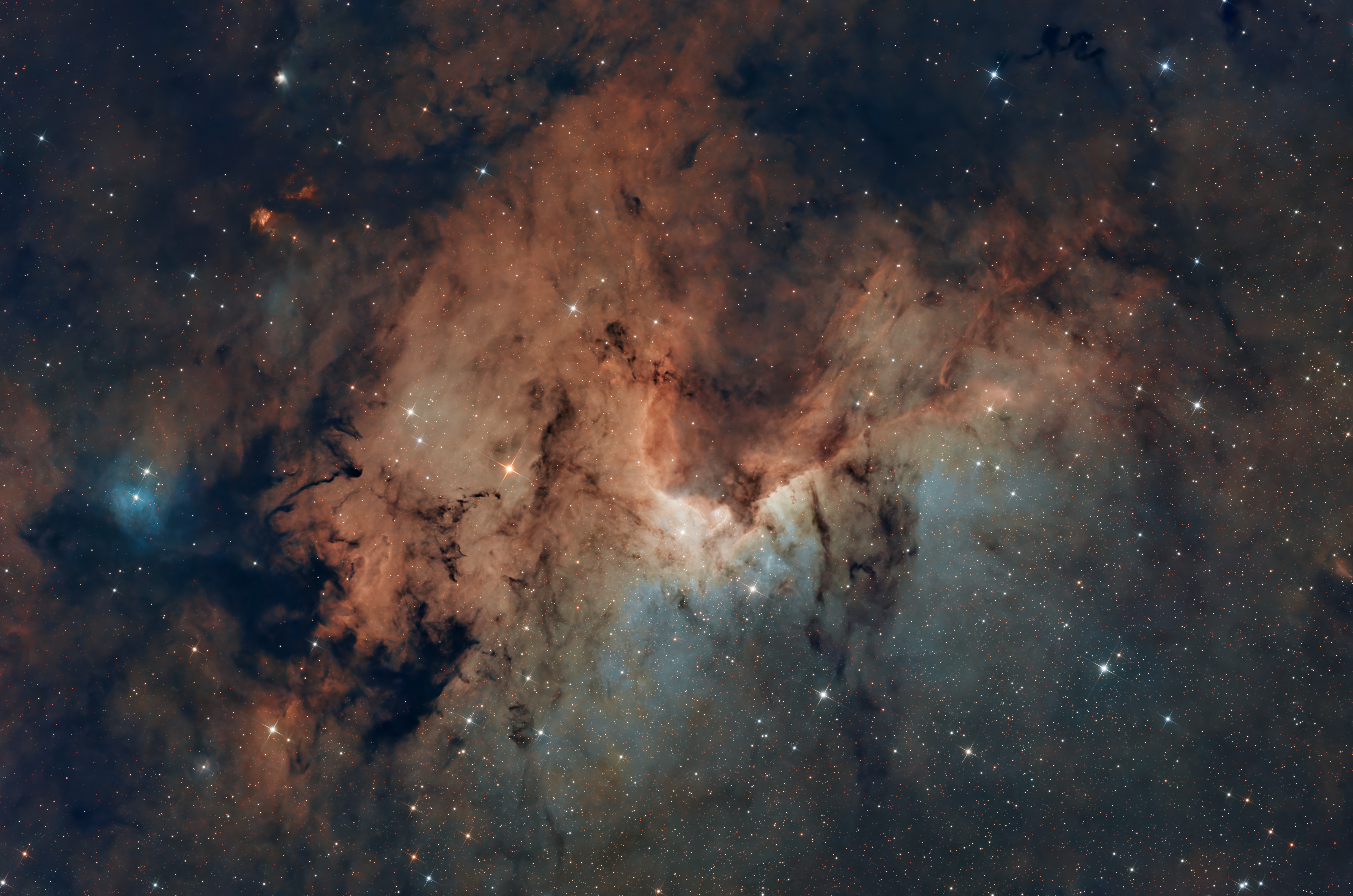
SH2-155
Key Astrophysical Data
Catalog Designations
Sh2-155, Caldwell 9, Cave Nebula
Position in the Sky
Cepheus (RA 22h 56m 48s / Dec +62° 36′ 21″)

Apparent Size
~50′ × 30′ (The greater complex)
Apparent Magnitude
~7.7 (Highly diffuse visual surface brightness)
Discovery Date
1959 (Stewart Sharpless catalog)
Object Type
Emission, Reflection & Dark Nebula Complex
Distance from Earth
~2,400 Light Years
Physical Size
~35 Light Years across
Power Source
HD 217086 (O7n star) / Cepheus OB3
Object Overview & Facts
Visual Appearance & Pareidolia: The signature feature of Sh2-155 is the striking dark ridge of obscuring dust along its western edge. Backlit by the glowing hydrogen gas, this thick molecular dust cloud visually hollows out a section of the nebula, giving observers the impression of looking directly into the mouth of a deep, dark cave illuminated from within.
The Cepheus OB3 Complex: Sh2-155 is deeply embedded within a much larger, sprawling molecular cloud structure known as the Cepheus B cloud, part of the Cepheus OB3 association. This larger environment is a massive laboratory of interstellar interaction where young, hot stars wage a continuous war against the cold gas that birthed them, creating breathtaking ridges, pillars, and glowing filaments.
Triggered Star Formation: The Cave Nebula is a textbook example of "triggered star formation." The radiation from the hot, massive O-type star HD 217086 is fiercely compressing the surrounding molecular gas. This violent compression triggers the collapse of dust and gas along the dense boundary (the very wall of the "cave"), sparking the ignition of a brand new generation of protostars hidden within the dark dust.
History of Discovery: While faint parts of the region were noted by early photographic surveys, it wasn't officially categorized until American astronomer Stewart Sharpless published his second catalog of H II regions in 1959. Later, it was popularized for amateur astronomers by Sir Patrick Moore, who included it as object number 9 in his famous Caldwell catalog.
Astrophotography Guide: For amateur astrophotographers, the Cave Nebula is a breathtaking but notoriously dim target. It requires significant integration time. While broadband imaging (RGB) yields a nice mix of the red emission gas and subtle reflection components, shooting the Cave Nebula in narrowband (the Hubble Palette: SHO) uncovers dramatic contrast, painting the sulfur in golds, hydrogen in rich rusts and yellows, and isolating the faint, ethereal blue halos of ionized oxygen.
Deep Sky Objects Size Comparison Laboratory
Interactive Scaling Explanation: This panel acts as a dynamic comparator of angular sizes in the night sky. All selected objects are rendered exactly over each other from a common center, allowing an immediate, direct comparison. The Full Moon (diameter 31') serves as a permanent baseline reference.
Cosmic Time Machine: SH2-155 vs. Earth's History
The Photon Arrives: Right now, the light captured in this photograph is ending its roughly 2,400-year journey through deep space, hitting your camera's digital sensor. Move the slider back in time to see what humanity was doing while these precise photons were rushing through the void.
Cosmic Scale: Distance Map Laboratory
Dynamic Linear Scaling & Manipulation: This view builds an interactive, deep-space linear cosmic coordinate system. When swapping objects, the line auto-calculates its limit. Leave only near targets (Pleiades, Orion) checked to reveal detailed stellar gaps inside our galactic neighborhood. Turn on remote galaxies (Andromeda, Whirlpool) to watch the Milky Way bundle together on the left margin. Use your mouse wheel to zoom in/out and drag to pan across space to explore cluttered zones!